More Attention. More Reach. More Sales. One Skill Gets You All Three

Here's the chain, and once you see it, you can't unsee it:
Better stories → more attention. More attention → more reach and recognition. More reach and recognition → more sales.
Every business you admire — the ones that seem to get noticed without trying, the ones whose customers do their marketing for them — didn't get there with a bigger budget.
They got there because people remembered what they said. And people remember what they're told as a story.
So the real question isn't "should I learn storytelling?" It's: how much is it costing you, right now, to be forgettable?

Four Studies Walk Into a Bar. They All Say the Same Thing
You don't have to take our word for it. Here's what the research actually says:
63% of people remember a story. Only 5% remember a statistic. In a Stanford classroom study, students gave one-minute pitches — nine in ten leaned on stats, one in ten told a story. Ten minutes later, researchers asked the audience what they recalled. A total 63% remembered the stories. Only 5% remembered a single statistic. (Stanford GSB research, popularized by Chip Heath, "Made to Stick")
Adding a story to a product can boost its perceived value by 2,706%. In the "Significant Objects" experiment, writers bought 100 cheap thrift-store items for $128.74 total, paired each with an invented short story, and resold them on eBay for $3,612.51 combined. (Significant Objects / Entrepreneur)
When people love a brand's story, 55% are more likely to buy in future, 44% will share it, and 15% buy immediately. From Headstream's 2015 Brand Storytelling Report, a survey of 2,000 UK adults. (The Drum)
Stories don't just change what people believe — they change what people DO. A meta-analysis of 15 controlled studies found statistics are better for shaping beliefs, but narratives are more effective at driving actual behavior. For a solopreneur, that's the one that matters: stories are what move someone from "interested" to "buying." (Zebregs et al., narrative vs. statistical evidence meta-analysis)
Four separate bodies of research. One conclusion: the businesses that tell better stories don't just get remembered — they get bought from.

That's the Theory. Here's the Receipts
Let me tell you about a soap company that should have lost.
For years, Dove sold what every other brand sold — a bar of soap, competing on price and ingredients. Forgettable. Then it stopped talking about soap. It started telling true stories about how real women see themselves. No new formula. No price cut. Just a different story. Sales climbed from around $2.5 billion to over $4 billion in the decade that followed.
That's not a fluke. It's a pattern — and once you see it, you can't unsee it.
Patagonia ran a full-page ad with a headline that should have been business suicide: "Don't Buy This Jacket." They told their customers to consume less. And because the story was honest, people trusted them more, not less. Sales rose about 30%, to roughly $543 million the very next year.
REI took it further. On Black Friday they closed all 143 stores and paid their staff to go outside. The story they told wasn't "buy now." It was "#OptOutside." More than a million new members joined the co-op that year. Digital sales grew 23%. Revenue rose 9.3%.
Now, maybe you're thinking: Sure, but those are giant brands with giant budgets. That's not me.
Five friends in Melbourne, Australia pooled $5,000 and sold a coffee scrub through a cheeky first-person voice called "Frank" that talked to customers like a mate. Frank Body now does over $20 million a year in 149 countries.
Mike Brown, a broke New York coffee roaster who'd moved back in with his mom, built a story — "the world's strongest coffee" — that won Death Wish Coffee a free Super Bowl ad. Sales jumped from $6 million to $20 million in one year.
Pippa Murray started Pip & Nut on a market stall in London. She got the business off the ground by living and working out of a rent-free "shed" incubator in the city in 2014, building the brand around her own founder story. Year one: £600,000. Today: a projected £35 million and the UK's #1 nut butter.
See the thread?
A soap empire and a one-person startup. Completely different scales — exact same lever. None of them won on better specs, lower prices, or louder ads. They won because they told a story people wanted to repeat.
That's the skill. And it's a skill — not a budget, not luck, not a gift you're born with. It can be learned, broken into steps, and applied to your business this week.
That's exactly why I built my quick course, the "No Fluff, Just Good Stuff™" Business Storytelling Masterclass. It takes the principles at work in stories like these and turns them into a simple, repeatable process you can actually use — built for businesses that don't have Dove's money, including yours.
You already have a story worth telling. Let me show you how to tell it so it sells.
You're Sitting on a Goldmine and You Don't Even Know It
Here's what I believe. Every business already has three to five great stories sitting inside it right now that could meaningfully grow that business — they just haven't been found, shaped, or told the right way yet.
You don't need a bigger budget. You don't need to invent something. The story is already there.
The story is already there. It's underneath the "About Us" page nobody reads, in the reason you started, in the customer who almost walked away and didn't, in the mistake that taught you the thing you now do better than anyone.
It's there. It just hasn't been pulled out yet.
If that's true, why doesn't it feel obvious?
Because you're too close to it. You've lived your own story so long you've stopped seeing what's interesting about it. The thing that would make a stranger lean in is, to you, just "Tuesday." That's not a flaw — it's just how proximity works. Nobody can read the label from inside the bottle.
That's the actual gap. Not creativity. Not writing talent. Not budget. Distance.
And distance is exactly what a framework fixes — you don't need to become more creative, you need a process that pulls the story out from where it's hiding.
I've Spent My Whole Career Figuring Out What Gets Attention

I've spent almost 30 years writing and editing for newspapers and a national broadcaster — work built entirely around grabbing a reader's or listener's attention from the very first line.
I started out as a business reporter, then spent 12 years in the US — including a stint at The Associated Press in Little Rock and nine years at The Salt Lake Tribune, where I went from copy-editing wire stories to helping decide which stories ran and revising the work of my colleagues.
Back in Ireland, I worked across both broadsheet and tabloid newsrooms, each with a completely different voice — which taught me, firsthand, that there's never just one right way to tell a story.
Somewhere in all of that I wrote more than 50,000 headlines. That's a career spent learning, the hard way, exactly what makes someone stop scrolling and keep reading.
I also wrote scripts and worked on-air for RTÉ Radio 1, Ireland's equivalent of the BBC. And underneath it all: a BA in Economics and Politics, a Master's in Journalism, a Professional Diploma in Digital Marketing, and an MA in Screenwriting with Distinction — the degree that sent me down the rabbit hole of how Hollywood story structure applies to the world of commerce.
Thirty years of figuring out what makes people stop, pay attention, and keep reading. This course is what I took from all of it.
72 Minutes. No Fluff. Just the Stuff That Works
The "No Fluff, Just Good Stuff™" Business Storytelling Masterclass is a 72-minute video course — 10 lessons, over 170 hand-picked visuals — that walks you through the exact, repeatable process for finding the stories already inside your business and turning them into content that gets remembered.
You'll learn:
- The creativity hack used by famous novelists
- The one question that simplifies your entire story
- What every story is actually about, underneath the surface
- The movie-trailer technique that makes a story land
- The quick fix that propels any story forward
Plus six bonuses, including:
- Stories for Biz E-Learning Directory — a 25-page study companion ($59 value)
- Digital audio version of the full Masterclass ($29 value)
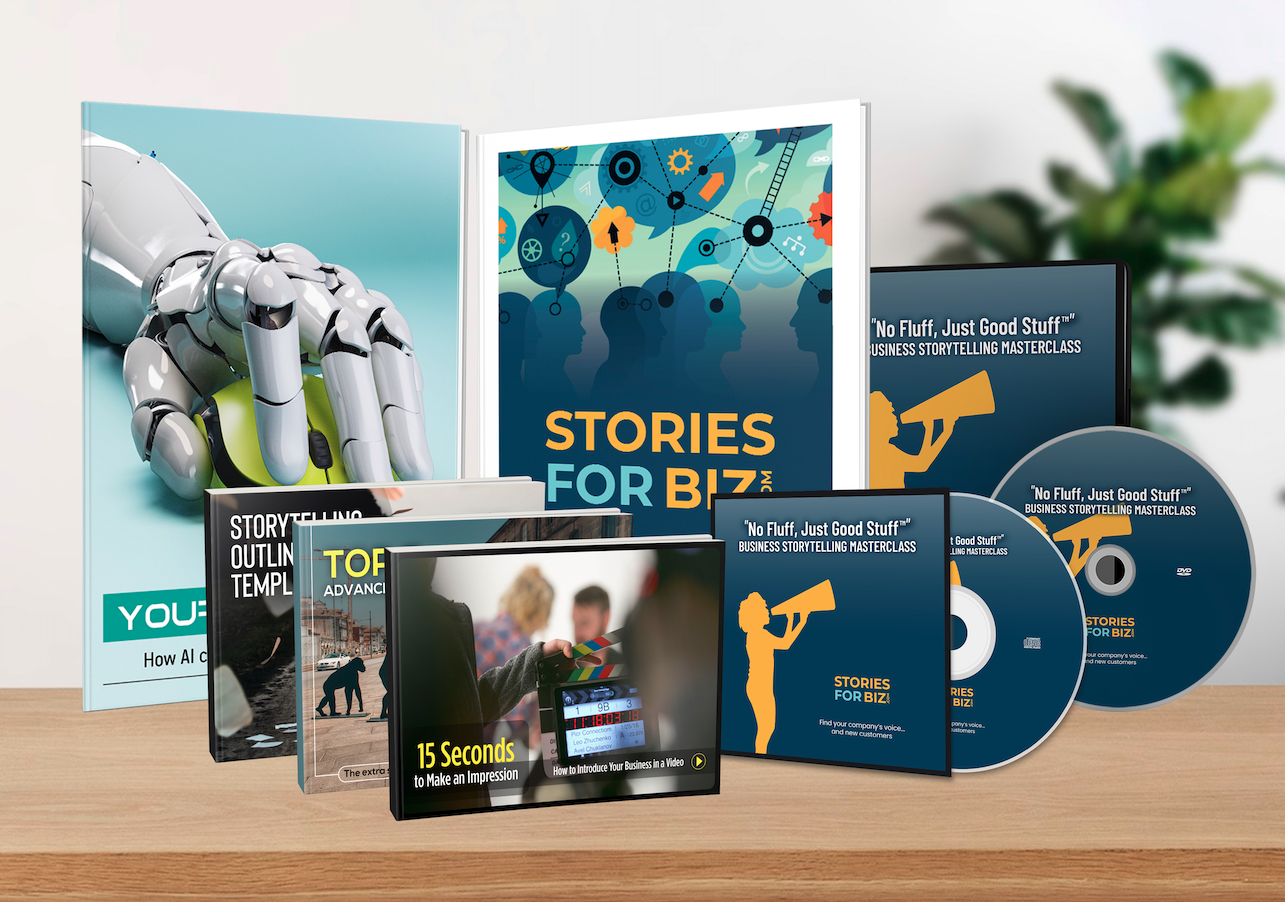
- Storytelling Outline Template — start your own narrative immediately ($39 value)
- "15 Seconds to Make an Impression" — intro-video guide with real examples ($39 value)
- My Top 5 Advanced Storytelling Tools ($29 value)
- "Your Assistant" — how to use AI to help complete your story, without losing the human part that actually persuades ($39 value)
Total value: $399 — yours today for $69, with a 30-day money-back guarantee. Watch it, use it, and if you don't feel like a narrative ninja within those 30 days, we'll refund you. No conditions.
What Solopreneurs say...

I’ve taken other storytelling courses and they were OK but Stories for Biz is excellent.
I sat down and watched the full course from start to finish - not because I was under pressure to do so, but because it was so good.
Mary Fleming, Brand Strategist and Designer
Mary Fleming
Brand Strategist and Designer

I wasn't really sure if I had a good story to tell about myself or my business, but your course made me realise that you can actually create a story that is relevant and connected to your business without just stating facts.
Ilona Madden, Certified Nutrition & Health Coach, Nutritional Therapist and Tourist Guide
Ilona Madden
Certified Nutrition & Health Coach, Nutritional Therapist and Tourist Guide

This masterclass is a bargain and surprisingly easy to consume. I liked that it was in bitesize form and I could also listen to the content on the go (like a podcast). I’m a busy mum of 3 so that helps! And I loved the reference to oxytocin and the neuroscience behind storytelling.
Negar Farah, Transformation Leadership Coach and Consultant
Negar Farah
Transformation Leadership Coach and Consultant
We're not Satisfied Until YOU Are
You get 30 days. Watch the course, work through the bonuses, give it a real chance. If you don't come away with a clear, usable grasp of how to tell your story in your own voice, just email us within those 30 days and we'll refund you. No hoops to jump through.
Quick questions
I don't know how to write. You don't need to be a writer. You need a structure — the same one sitting underneath every brand story and ad that's ever made you feel something.
Why this course and not someone else's? Because most storytelling advice is theory without a method behind it. This comes from someone who's spent 30 years studying exactly how stories are built, broken down for a solopreneur who doesn't have time to spare.
I don't have time for a whole course. It's 72 minutes, total. Watch it in one sitting, or in five-minute pieces between client calls. In a matter of hours - an hour for the masterclass and less than three hours for all the other materials - you can become an expert in using stories to boost your business.
Won't AI just do this for me? AI can string sentences together. It can't tell your story, because it wasn't there for it. One of the bonuses shows you how to use AI alongside your own voice, not as a replacement for it.